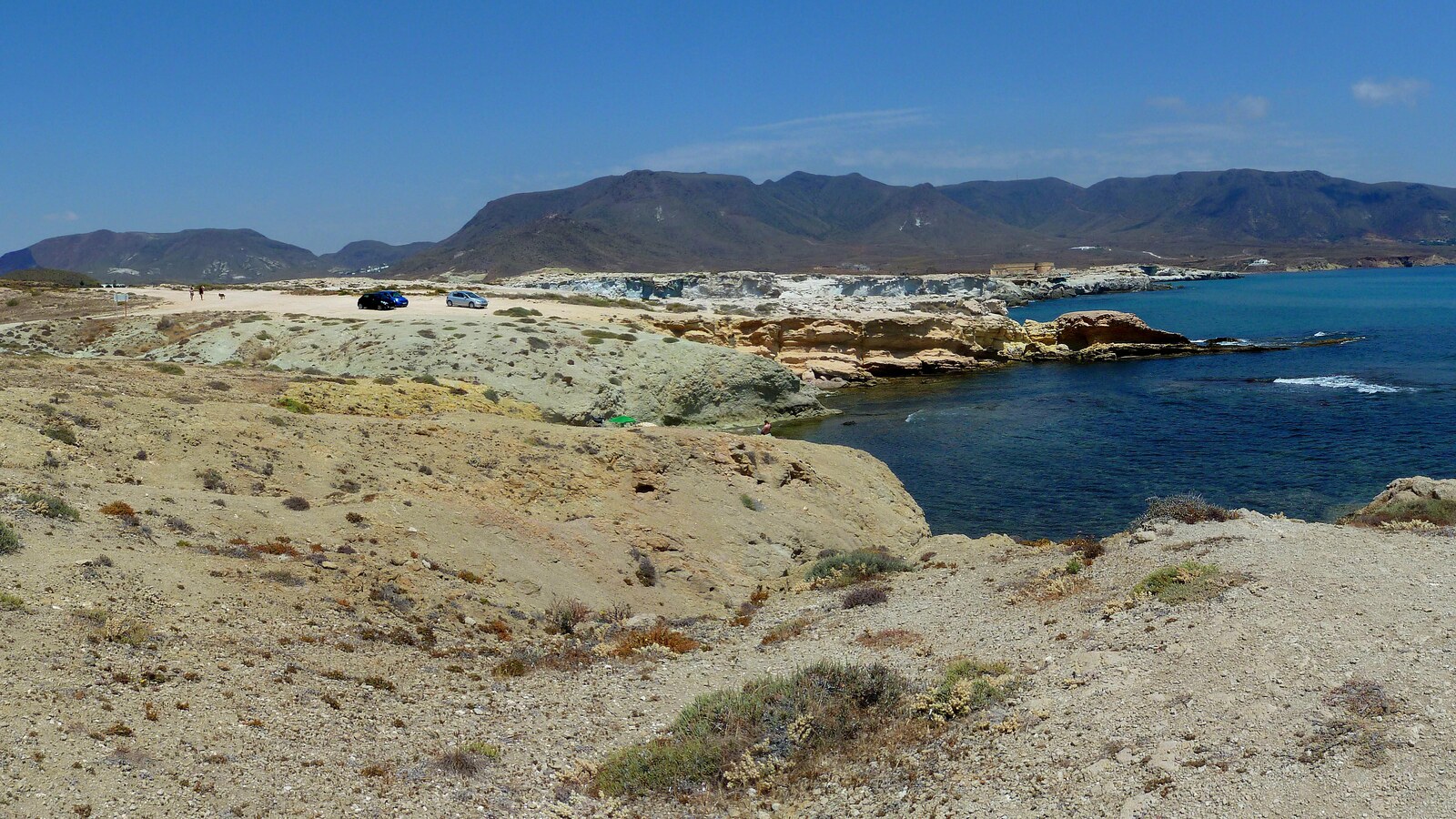
This linear walk starts at Mirador de La Isleta del Moro, follows low cliffs and small coves to Los Escullos, and finishes at Playa del Embarcadero. It is about 3.6 km and roughly 1 hour 15 minutes of walking, but the fossil dune, castle and snorkelling make it worth setting aside half a day.
From the viewpoint to the path above the sea
The viewpoint reveals almost the entire route: Los Escullos bay, the pale rocks by Playa del Arco and the twin volcanic heights of Los Frailes. Head towards the marked Escullos–Isleta del Moro trail and stay on the worn path above the coast.
The first section rises and falls through small dry gullies and low cliffs. It is not technically difficult, but the ground can be loose and stony. Closed shoes with a grippy sole are much more comfortable and secure than sandals.
Cala Violeta, Playa del Esparto and Playa del Arco
The path passes tiny Cala Violeta and stretches known as Playa del Esparto. Here the scenery shifts quickly from darker volcanic rock to pale deposits, while the view opens across the bay. There is no need to descend into every cove; some of the finest views are a few metres above the water.
After about 2.2 km you reach Playa del Arco, the main beach at Los Escullos. Sand mixes with stones, and rock shelves and small pools appear along the shore. On a calm day it is tempting to look underwater here, although El Embarcadero is the better place for a longer snorkelling stop.
Duna Fósil: a dune turned to stone
Los Escullos’ most unusual formation is the Duna Fósil. It is not solidified lava, but an ancient dune made from calcareous grains — ooids — that were gradually cemented into hard rock. Its layers preserve evidence of a former marine environment and shoreline.
Wind and waves have carved ledges, hollows and sculptural shapes into the pale stone. The formation is fragile, however. View it from the existing paths, do not climb exposed edges, break pieces off or scratch names into the surface.
San Felipe castle and the coast’s history
Beyond Playa del Arco stands the Batería de San Felipe, a coastal fort built in 1771 during the reign of Charles III to watch and defend the shoreline. It was restored in 1991. Its severe outline is a reminder that this apparently remote bay once held real strategic importance.
From the castle there is about one kilometre left to the finish. The route becomes easier beside the road and along a dirt access track, while the bay closes beneath Cerro de los Frailes.
Finish at Playa del Embarcadero: mask and snorkel
Playa del Embarcadero is around 320 m long and one of the most rewarding places for gentle snorkelling in this part of the park. Rocky seabed alternates with meadows of Posidonia oceanica. Posidonia is not an alga but a flowering marine plant that stabilises the seabed and shelters hundreds of species.
In good visibility you may see shoals of small fish, starfish and sea urchins. Octopuses hide in rock crevices and along the edge of the Posidonia; a sighting is possible, never guaranteed. They are often revealed by a slight change in a rock’s colour or texture rather than by movement.
Los Escullos also has protected reefs built by tiny vermetid molluscs together with calcareous algae. They resemble rough rock platforms. Do not stand on them, touch wildlife or take anything from the water. Water shoes help with sharp rock and reduce the chance of accidentally stepping on a sea urchin.
How to plan the walk well
- Allow around 1 hour 15 minutes for walking; with photos, sightseeing and snorkelling, plan for 2.5–3.5 hours.
- Carry water, a hat and sun protection: there is virtually no shade on the route.
- Wear walking shoes or trainers and pack water shoes, a mask and snorkel.
- Check the wind and swell before entering the sea. Skip snorkelling if the water is rough or visibility is poor.
- Swim with another person, remain near shore and keep clear of boats and launching areas.
- Arrange collection at the small Playa del Embarcadero car park or include the walk back in your plan.
A short walk with the full Cabo de Gata story
Within just a few kilometres, three stories meet: the park’s volcanic landscape, a former shoreline turned to stone and a living Mediterranean seabed. It is an ideal outing from La Isleta del Moro when you want light hiking, geology, history and time in the water without committing to a full-day trek.
Sources and planning
- Mirador–Embarcadero track and route statistics — Wikiloc
- Official Escullos–Isleta del Moro trail — Junta de Andalucía
- Fossil dune, San Felipe battery and trail — Turismo Níjar
- El Embarcadero beach and Posidonia meadows — Turismo Níjar
- Geopark seabed and marine life — Junta de Andalucía
- Management plan: reefs, Posidonia and marine species — BOJA
- Photo: Los Escullos de Cabo de Gata by José Antonio Huertas, CC BY-SA 4.0 · cropped.