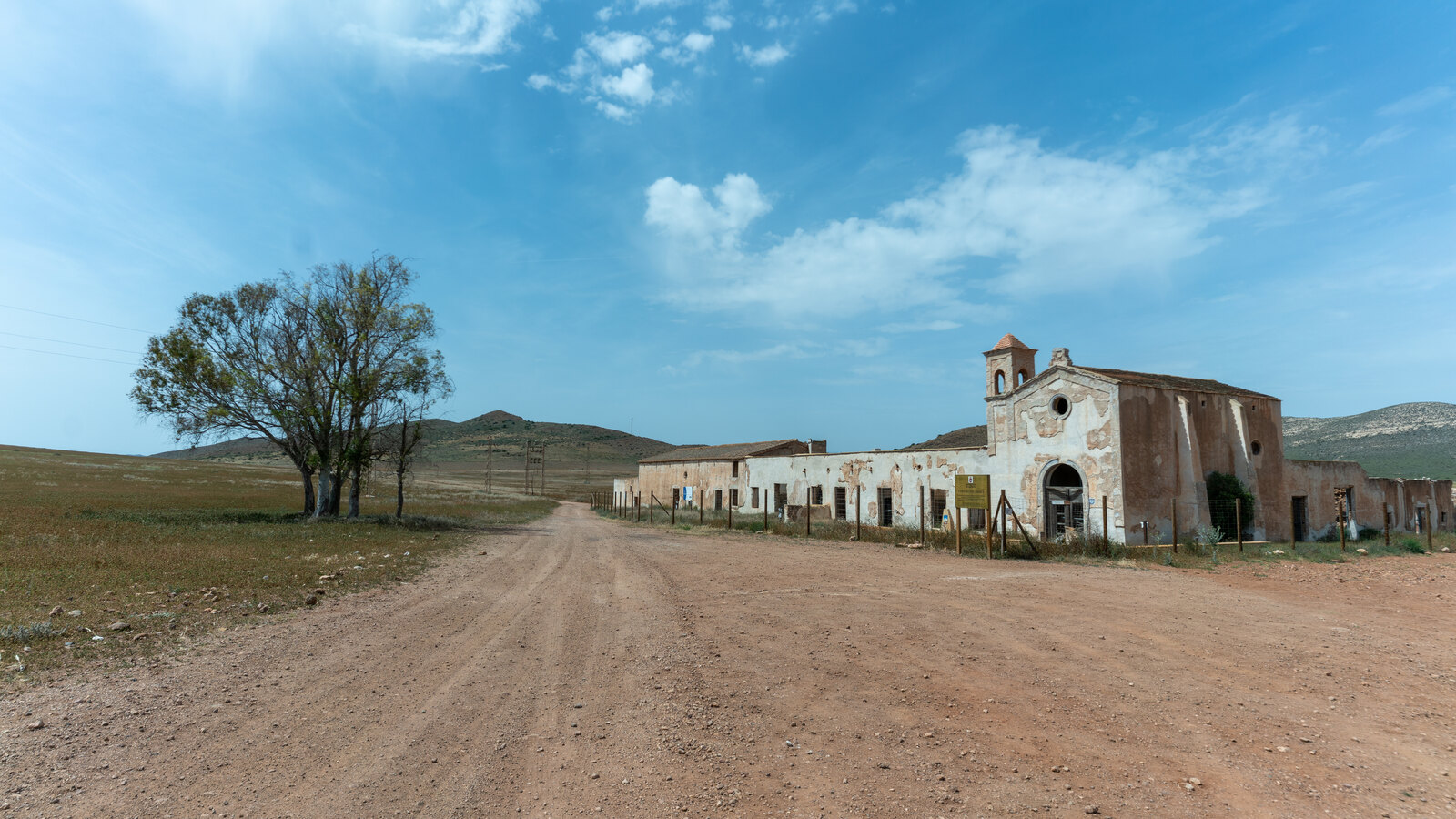
Cortijo del Fraile is more than a photogenic ruin on an arid plain. It brings together the history of dryland farming, the real-life Crime of Níjar, the writing of Carmen de Burgos and Federico García Lorca, and Sergio Leone’s cinematic landscapes. From La Isleta del Moro it makes an excellent half- or full-day trip by car, bicycle and, optionally, on foot.
The best itinerary: Los Albaricoques, Cortijo and Rodalquilar
Drive from La Isleta del Moro towards Los Albaricoques first. This small settlement became a natural set for European westerns; its threshing floor, white houses and open plain still feel ready for filming. From here, the official S16 link reaches Cortijo del Fraile along a section surfaced with ecological concrete and shared by vehicles, cyclists and walkers.
At the Cortijo, either take time to view the complex from the permitted areas or add the S11 circular trail through the abandoned farmsteads of Montano and Hornillo. Turismo Níjar gives the walk as 7.7 km and about three hours. Finish in Rodalquilar for a drink, the former mining village or a short walk. One outing then connects three stories of this landscape: farming, film and mining.
What exactly was Cortijo del Fraile?
Today’s ruins once formed a large, almost self-contained agricultural and pastoral estate. The plot covers more than 3,000 m², with around 1,835 m² of buildings. Arranged around an inner courtyard were the owners’ house, accommodation for tenant farmers and shepherds, stables, livestock pens, stores, ovens and a chapel with a small bell tower. There were also a crypt, threshing floors, wells, cisterns and watering troughs.
Water was the decisive part of the design. Two vaulted cisterns collected scarce rainfall, supplying troughs, animals and crops. Olives, vines, grain and grazing all depended on capturing every runoff. Look beyond the chapel to the terrace walls, channels and field patterns: they reveal how people actually lived here.
From Dominican estate to abandonment
Dominican friars from Almería’s Santo Domingo convent built the Cortijo in the 18th century as a major farming and livestock estate. They gave it the name del Fraile — “of the friar”. Following the Mendizábal confiscations of 1836, the state seized the property and it passed into private ownership.
A prosperous Almería family later acquired it, developed the religious part of the complex and used the hermitage as a family pantheon until 1980. During the 20th century, the surrounding farmsteads gradually lost their population; the closure of the Rodalquilar mines in the 1960s hastened the exodus. What remains is an exceptional record of rural life in Cabo de Gata, but also a building exposed for decades to wind, rain and neglect.
The Crime of Níjar: one event, two major works
On the night of 22–23 July 1928, shortly before a planned wedding at the Cortijo, Francisca Cañadas fled with the man she loved, her cousin Francisco Montes. They were caught: Montes was killed and Francisca survived, injured. Remembered as the Crime of Níjar, the case caused a sensation in the contemporary press.
Almería-born writer and journalist Carmen de Burgos “Colombine” first transformed it into literature in Puñal de claveles (1931). Two years later Federico García Lorca premiered Blood Wedding. Both works grow from the same event, but alter characters, motives and endings. The Cortijo is therefore not merely the backdrop to a crime story: it is where real conflicts over marriage, honour, property and freedom of choice entered world literature.
A western landscape for Sergio Leone
The bare plain, isolated agaves and strong silhouette of the farmhouse also drew filmmakers. The Cortijo and its surroundings appear in For a Few Dollars More and The Good, the Bad and the Ugly. Los Albaricoques featured in westerns too, making it a natural companion stop. Rather than hunting for one frame, take in the scale of the landscape — that openness allowed Almería to stand in for the American West.
What to look for
- The chapel and bell tower, the complex’s most recognisable profile.
- The courtyard and farm buildings, viewed only from authorised areas because the structures may be unstable.
- The cisterns and troughs, the key to farming in semi-arid Cabo de Gata.
- The open plain, particularly photogenic early and in the last light of the day.
- The Montano–Hornillo circuit, an easy option among abandoned farms, stone terraces and old fields.
Access, cycling and safety
The simplest approach is via Los Albaricoques. The official S16 description identifies a link suitable for vehicles, cyclists and pedestrians, although side sections may be uneven. Conditions can change after heavy rain or during building work, so obey local signs and never enter a closed track.
Cortijo del Fraile is a protected cultural monument and is undergoing a gradual programme of consolidation ahead of restoration. For now, treat it as an exterior visit: respect fences, do not enter the ruins and never climb the walls. The plain has almost no shade, so bring water, a hat and sun protection even outside summer.
What else should you include?
Los Albaricoques: a short cinema stop
Pause at the old threshing floor and walk a few streets. It is the best introduction to the area’s film history and a useful starting point for a bicycle or walking approach to the Cortijo.
Rodalquilar: gold, gardens and coffee
Continue to Rodalquilar after the Cortijo. Explore the former mining settlement, visit the botanical garden or use our guide to the Rodalquilar gold mines. It is a logical finale because the decline of mining also affected the population of nearby estates.
The S11 circuit: Montano and Hornillo
For a slower experience, choose the signed 7.7 km loop. It is rated easy, but crosses exposed ground and takes about three hours. Carry an offline route or map and do not shortcut across private land.
Frequently asked questions
Can you go inside Cortijo del Fraile?
Do not assume interior access. The building’s condition and construction zones may change; view it from permitted areas and always follow current fencing and signs.
Do you have to walk?
No. You can reach the main sight via Los Albaricoques. The S11 walk is an optional extra for anyone wanting to understand the farming landscape and abandoned settlements.
When is the best time to visit?
Autumn, winter and spring offer more comfortable temperatures. In summer, go early or late in the day; the lack of shade matters more than the distance.
What is happening to the monument?
After the site came into public ownership, the Diputación de Almería launched structural consolidation and a full restoration plan. In 2026 it presented a proposal for a future “Centre for Arts and Territory”, combining the architecture, agricultural landscape and memory of the site. Visiting conditions may change as work progresses.
Sources and planning
- S11 Cortijo del Fraile–Montano–Hornillo: official trail data — Turismo Níjar
- S16 Los Albaricoques–Cortijo–Rodalquilar cycle and walking link — Turismo Níjar
- The Cortijo’s architecture, history and heritage — Níjar Council
- Puñal de claveles and the Crime of Níjar — Miguel de Cervantes Virtual Library
- Master Plan and future Centre for Arts and Territory — Diputación de Almería
- Photo: Cortijo del Fraile, abandoned farmstead of the Blood Wedding near Níjar (2026) by Paul Colin Hennig / firstdorsal.eu, CC BY-SA 4.0 · cropped and resized.